
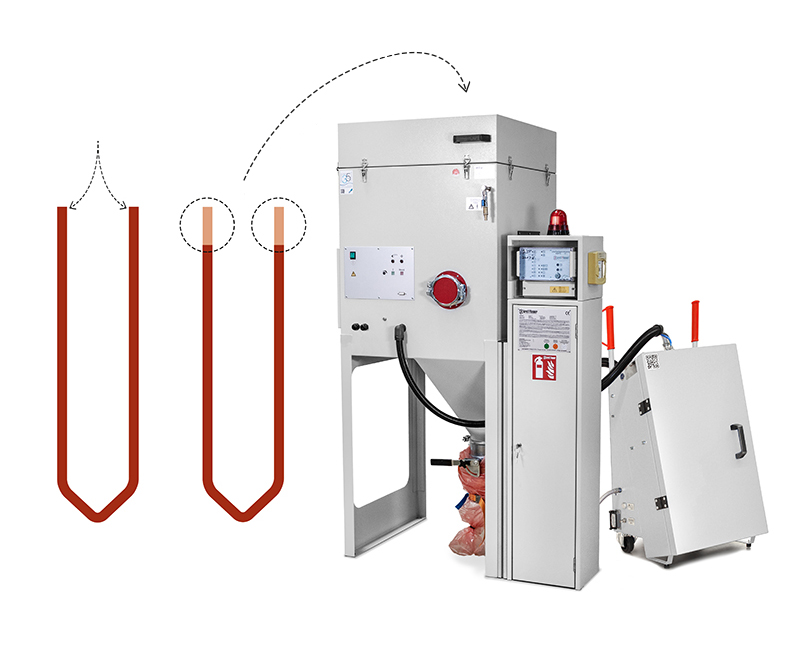
E-Mobility – pollution problems when stripping insulation from the hairpin? We solve them.
The problem:
For fitting to the stators or rotors of electric motors, the insulation of the copper hairpins is partially removed by lasering or milling. This creates harmful emissions but also fire risks because the temperature-resistant, insulating plastic varnishes usually have high combustion factors and tend towards agglomeration. Attention must be paid to the spark separation when stripping the insulation with lasers. Sticky residues make a precoating necessary.
Our solution:
The MKFV / INRV / IFVA extraction units are the ideal basis for the large emission quantities and volume flows that occur. We supplement these with fire protection measures such as inerting, horizontal spark separator or CO2 extinguishing systems. All parts that come into contact with emissions such as paints, filters, hoses, etc. are installed in ESD versions as a further safety feature.
The conclusion:
Especially where special processes of new technologies and the material used therein are concerned, Fuchs Umwelttechnik is the ideal partner for sophisticated, effective special extraction solutions which can offer the right solution for every requirement.
More important than ever before: Sophisticated solutions for the COLLECTION, EXTRACTION, AND FILTRATION OF AIR POLLUTANTS
The international trade fair for plastics processing, FAKUMA, is opening its gates for the 30th time from the 12th to the 16th of October 2026 in Friedrichshafen.
Plastics are a constant companion in all areas of daily life world-wide. An incredible amount in the production and processing of which various pollutants occur which must be treated accordingly and which demand a competent specialist.
This specialist, Fuchs Umwelttechnik, will this year – following their successful fair appearance at the 2024 – again be presenting sophisticated new products and efficient safety solutions for the collection and filtration of all air pollutants in plastic production and processing!
Our competent team of engineers await you at the Fuchs Umwelttechnik booth A1-1210 in Hall A1 and look forward to a constructive exchange on all questions to do with the elimination of your pollutant emissions.
In addition to a special selection from our versatile modular product portfolio, you can find out all about highly practical new developments and further highlights! Look out for a quick preview in a later newsflash.
Visit Fuchs Umwelttechnik at this year’s anniversary Fakuma. You can reserve your free personal entrance ticket with the ticket voucher button on our website.
The Fuchs Umwelttechnik team are looking forward to meeting you. We will take time to answer your questions and discuss your individual wises on site.
Cash in your ticket voucher for this fair now. See you at our fair booth!
The CCMT 2026 (Shanghai International Fair for CNC Machine Tool Components & Attachments) was held at the end of April 2026 in Shanghai, China, and is one of the world’s most important trade fairs for machine tools. Over an exhibition area with 20 halls and about 2,000 booths, the focus was on topics such as CNC technology, metal processing and intelligent production.
Fuchs Umwelttechnik were represented exclusively at the fair by their sales partner NUOSUN. Numerous professional visitors showed a strong interest in the subject of air purification and had the details of products from Fuchs Umwelttechnik explained to them on site by NUOSUN.
In addition, our partner NUOSUN made numerous contacts with Asian laser machine manufacturers. The talks provided an interesting insight into the requirements and perspectives of the Asian market which we will incorporate into our future planning.
On the whole, we can draw positive conclusions from the CCMT 2026: The visitors’ interest was great, the response positive in every respect and many valuable contacts with interesting manufacturers could be made. The fair therefore fulfilled all our expectations.
Fuchs Umwelttechnik and Pantron Automation are founding a new partnership with the Fountain Inn High School in South Carolina to support and encourage future generations of qualified skilled professionals. As a pioneer of training in progressive production and technology, the school creates close relations between industry and teaching from which all those involved gain lasting benefits.
The cooperation began at the Pantron Automation booth at the SouthTec Fair 2025, USA. From a technical exchange on the powerful, highly modern extraction technology of Fuchs Umwelttechnik, a strategic dialogue on the changing requirements of modern production and the possibilities of targeted qualification of young talent developed.
The background: This is exactly the principle that the Fountain Inn High School follows, to prepare their students for careers in progressive production, engineering and related technical fields with special programmes, says Ken Barker, specialist teacher at the educational facility. With both practical training courses and a syllabus that is also adapted to industry, the school responds appropriately to the growing demand for skilled personnel and engineering talents.
The implementation: A progressively operating educational institution and two competent international industrial partners create an effective win-win situation for all parties: the excellent preparation of skilled workers for constant innovation in industry. Together, they help young people to acquire the knowledge, the tools and the practical experience that they need for a successful career in the high-tech branch.
The success: Industry gets qualified recruits, whilst the trainees gain access to state-of-the-art technology and realistic insight into industrial processes. Fuchs Umwelttechnik, Pantron Automation and the Fountain Inn High School thereby emphasize their common commitment to innovation, quality and a strong, sustainable workforce development.

